my clay bodies and glazes
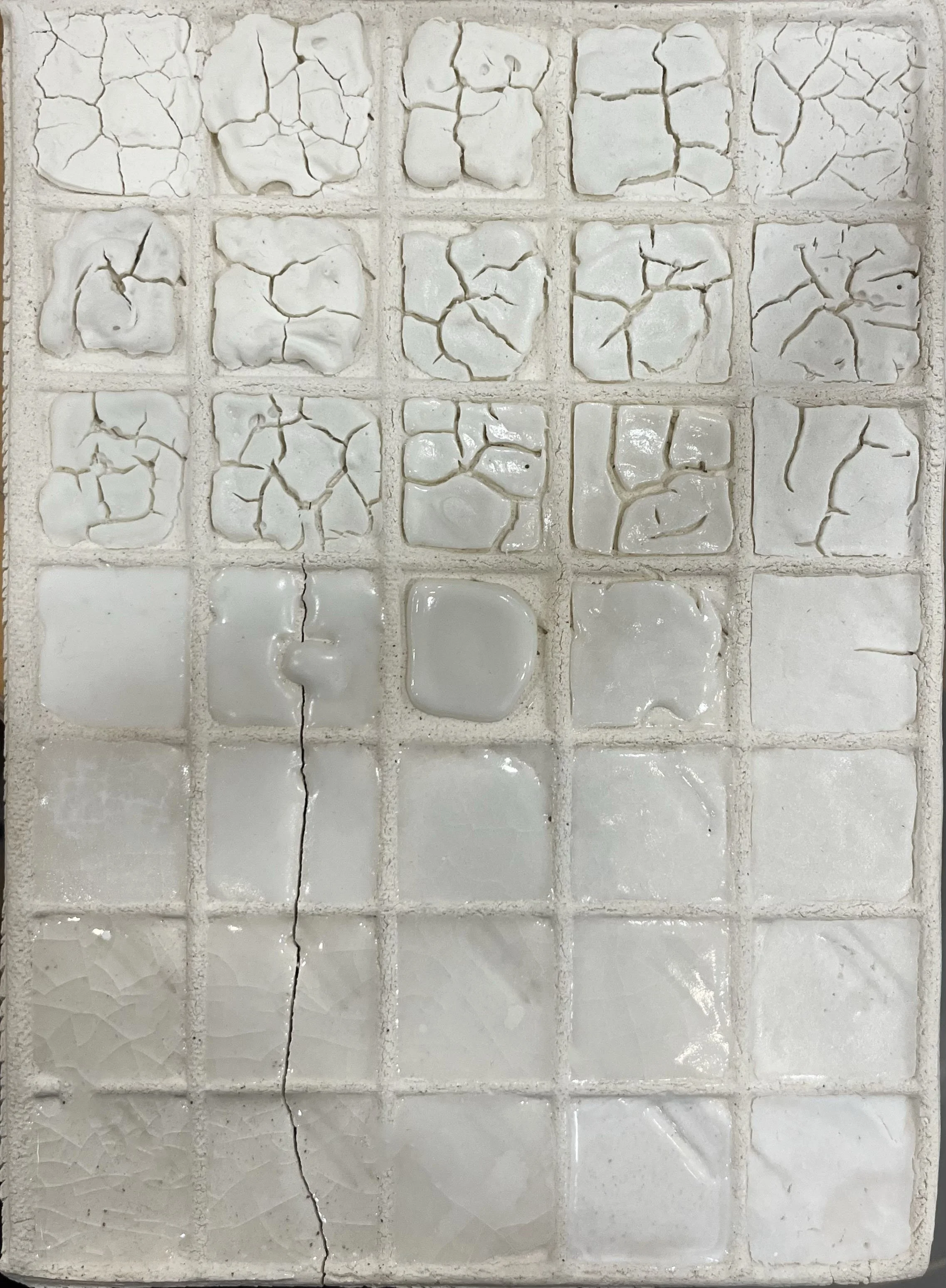
Starting “Quadraxial” tile (Ian Currie’s glaze testing method) used in the development of my
“Salinas Bristol”
As of recent, here is a provided list of the materials I have been using. These recipes are cumulative of what I have learned during my time in undergrad, and are serving me well for the time being.
Clay Body:
Soojin Choi Cone 6 White Clay Body
G200 Feldspar 35
Grolleg 25
Silica 20
Tile #6 Kaolin 10
KT OM#4 10
Bentonite 2%
48 mesh Molochite 15%
100 mesh Molochite 5%
This clay body only undergoes a cycle of 3 recycles before it looses plasticity and begins cracking at curves, I recommend adding in new dry material to wet reclaim after about the second or third reclaim cycle. In general, this clay is very forgiving when it comes to sculptural forms and vessels with many or extreme curves. It does NOT work well as a throwing body (learned that the hard way). Its texture is somewhat of a porcelaneous stoneware, and smoothes out well depending on the mesh of grog. It is most workable at a firmer texture, rather than wet, as it does have that “runny” texture that porcelain does.
Glazes:
Ben Feiss 0116009 (Psychedelic Celadon) ^6
EPK 20.80
Ferro Frit 3134 19.60
Wollastonite 18.80
Silica 16.90
Petalite (Li) 16.50
Zinc Oxide 7.30
Copper Carbonate 0.50
(if I want a more pronounced color without the running and pooling, I add 0.65 of the Copper Carbonate in place of the 0.50)
Sarah’s Clear ^6
Nepheline Syenite 30
Silica 30
Gillespie Borate 20
EPK 10
Wollastonite 10
Bentonite 2
(apply thin, when too thick it produces pinholes and runs excessively)
Salinas Bristol ^6
Minspar 200 59.11
Wollastonite 15.46
Zinc Oxide 7.31
EPK 6.04
Silica12.08
Colorants:
Copper Carbonate 3% (green, hint of blue)
Red Iron Oxide 3%, Chrome 0.5% (deep blue)
Red Iron Oxide 3%, Cobalt 0.5%, Rutile 3% (transparent yellow green)
Cobalt 0.5%, Rutile 3% (blue green, somewhat of a celadon color)
And of course, for my decorations I use the Amaco Velvet Underglazes. Typically, I water them down to a 2 parts underglaze / 1 part water. With this, I mix each color individually, similar to paint. I’m not sure if I would recommend this, as it runs the risk of coming out looking differently underneath a clear glaze. The velvet underglazes are my tried and true, and it has taken lots of trial and error to push this material to something beyond an entry-level product.
ALL glazes are fired in oxidation, with no special programmed holds.
